English
English
Español
Português
русский
français
日本語
Deutsch
Tiếng Việt
Italiano
Nederlands
ไทย
Polski
한국어
Svenska
magyar
Malay
বাংলা
Dansk
Suomi
हिन्दी
Pilipino
Türk
Gaeilge
عربى
Indonesia
norsk
اردو
čeština
Ελληνικά
Українська
Javanese
فارسی
தமிழ்
తెలుగు
नेपाली
Burmese
български
ລາວ
Latine
Қазақ
Euskal
Azərbaycan
slovenský
Македонски
Lietuvos
Eesti Keel
Română
Slovenski
मराठी
Српски
Esperanto
Afrikaans
Català
עִברִית
Cymraeg
Galego
Latvietis
icelandic
יידיש
Беларус
Hrvatski
Kreyòl ayisyen
Shqiptar
Malti
lugha ya Kiswahili
አማርኛ
Bosanski
Frysk
ជនជាតិខ្មែរ
ქართული
ગુજરાતી
Hausa
Кыргыз тили
ಕನ್ನಡ
Corsa
Kurdî
മലയാളം
Maori
Монгол хэл
Hmong
IsiXhosa
Zulu
Punjabi
پښتو
Chichewa
Samoa
Sesotho
සිංහල
Gàidhlig
Cebuano
Somali
Точик
O'zbek
Hawaiian
سنڌي
Shinra
հայերեն
Igbo
Sundanese
Lëtzebuergesch
Malagasy
Yoruba
Javanese
Banbala
Pokjoper
Divih
Philippine
Gwadani
Elokano

The pipeline medium in the coking plant area is complex, and tar, ammonia water, and condensate are prone to low-temperature solidification and blockage of pipelines. In addition, outdoor pipelines are exposed to wind, snow, and severe cold, which can easily cause transportation interruptions and equipment shutdowns. Electric heating relies on continuous constant temperature heating, starting from pipeline antifreeze and anti condensation, to ensure the continuous operation of the entire coking production process. It is an indispensable supporting facility for plant operation and maintenance.

There are numerous pipelines in the coking production process, including crude gas pipelines, ammonia water pipelines, tar recovery pipelines, and instrument pipelines in the chemical production workshop. The medium viscosity is high and the solidification point is relatively high. After the ambient temperature drops, the flowability of materials deteriorates, and the pipe wall is prone to sedimentation and agglomeration. In mild cases, the pipeline flow is insufficient, and in severe cases, the pipeline is completely blocked. The production line is forced to shut down for cleaning, which not only consumes raw materials but also slows down the overall production progress. Some outdoor storage tanks, valves, and drainage points dissipate heat quickly, and lack insulation and heat tracing, which can easily lead to frost cracking and leakage, posing safety and environmental hazards.
There are clear standards for selection in response to the harsh working conditions of coking explosion prevention, corrosion prevention, and constant temperature. The factory area mostly belongs to explosion-proof hazardous areas, and explosion-proof self limiting temperature or constant power electric heat tracing belts must be selected. Conventional transmission pipelines use medium temperature explosion-proof self limiting heat tracing belts, which can independently adjust power and prevent local overheating; The long-distance main transmission pipeline is equipped with a constant power heating belt, ensuring uniform heating throughout the entire line and preventing insufficient temperature at the end of the long-distance transmission. For pipelines that come into contact with acidic and alkaline wastewater and corrosive flue gas, fluoroplastic anti-corrosion outer sheath models should be selected to resist chemical media erosion and delay cable aging and damage.
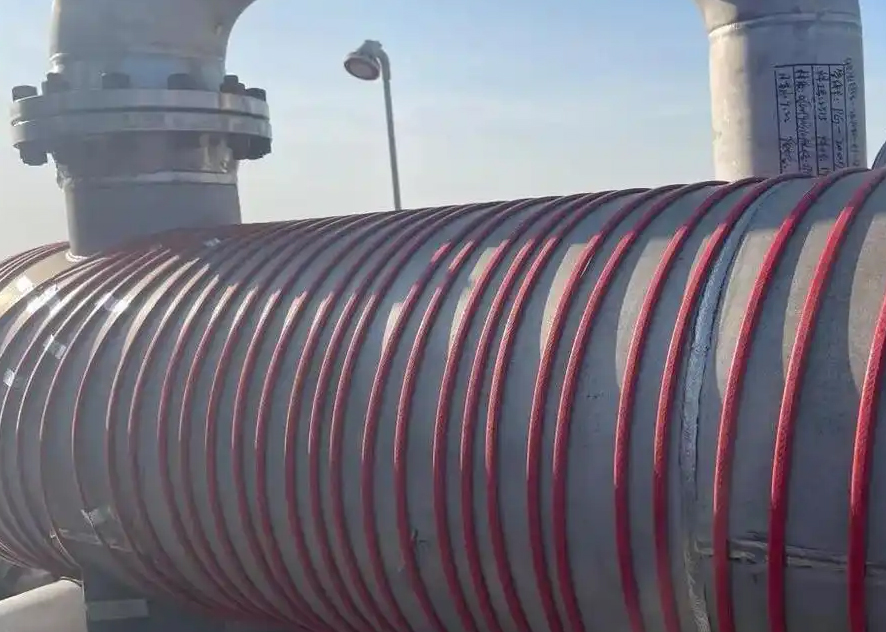
The on-site construction strictly follows the explosion-proof construction specifications, and the heat tracing strip is flat and pasted on the pipe wall. The installation length of key heat dissipation parts such as valves, tees, and flanges is increased to eliminate insulation blind spots. Use pressure-sensitive tape to secure cables and prevent sharp iron wires from scratching the insulation layer. All junction boxes and terminals are equipped with explosion-proof sealing accessories, with waterproof and dustproof sealing treatment. The shielding layer is properly grounded to avoid safety risks caused by leakage and electric sparks. The outer layer is wrapped with insulation and protective shell to reduce heat loss and lower electricity consumption.
Daily operation and maintenance management can effectively extend the service life of the heat tracing system. Before entering winter, conduct a comprehensive inspection of the insulation resistance of the circuit and check for any cracks, aging, corrosion, or damage to the protective sheath; During the shutdown and maintenance period, power off to identify the fault location and replace the faulty cables in a timely manner. Equipped with temperature control distribution box partition control circuit, start and stop the heat tracing circuit as needed to avoid unnecessary power consumption caused by all-weather no-load power on.
The coking industry has a strong attribute of continuous production, and once the pipeline is blocked, it will cause chain production failures. The electric tracing system accurately controls temperature, prevents condensation and freezing, adapts to the special environment of explosion-proof and anti-corrosion in the factory area, reduces pipeline dredging and equipment maintenance frequency, not only improves production continuity but also reduces safety hazards in the factory area, laying a solid foundation for long-term stable production of coking enterprises.