English
English
Español
Português
русский
français
日本語
Deutsch
Tiếng Việt
Italiano
Nederlands
ไทย
Polski
한국어
Svenska
magyar
Malay
বাংলা
Dansk
Suomi
हिन्दी
Pilipino
Türk
Gaeilge
عربى
Indonesia
norsk
اردو
čeština
Ελληνικά
Українська
Javanese
فارسی
தமிழ்
తెలుగు
नेपाली
Burmese
български
ລາວ
Latine
Қазақ
Euskal
Azərbaycan
slovenský
Македонски
Lietuvos
Eesti Keel
Română
Slovenski
मराठी
Српски
Esperanto
Afrikaans
Català
עִברִית
Cymraeg
Galego
Latvietis
icelandic
יידיש
Беларус
Hrvatski
Kreyòl ayisyen
Shqiptar
Malti
lugha ya Kiswahili
አማርኛ
Bosanski
Frysk
ជនជាតិខ្មែរ
ქართული
ગુજરાતી
Hausa
Кыргыз тили
ಕನ್ನಡ
Corsa
Kurdî
മലയാളം
Maori
Монгол хэл
Hmong
IsiXhosa
Zulu
Punjabi
پښتو
Chichewa
Samoa
Sesotho
සිංහල
Gàidhlig
Cebuano
Somali
Точик
O'zbek
Hawaiian
سنڌي
Shinra
հայերեն
Igbo
Sundanese
Lëtzebuergesch
Malagasy
Yoruba
Javanese
Banbala
Pokjoper
Divih
Philippine
Gwadani
Elokano

Electrical heat‑tracing has become a mainstream alternative to legacy steam tracing for pipeline freeze prevention and process temperature retention within global oil‑gas, chemical and resource‑processing industries. Design engineers face core decision‑making points when selecting between parallel‑resistance and series‑connected constant‑power heating cable architectures.
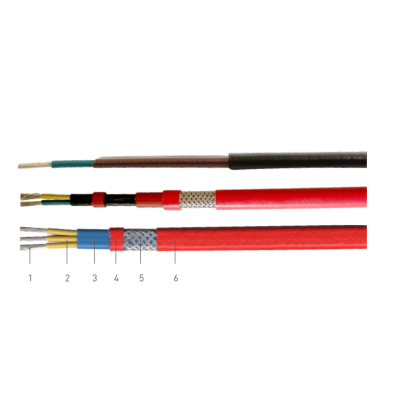
Parallel constant‑wattage and self‑regulating heat‑tracing cables work well for medium‑length piping runs, yet they suffer practical upper limits for single‑supply circuit length. When project layouts demand trace‑heating over several‑kilometer continuous pipeline segments, series‑connected constant‑power solutions represented by HGC‑1 and HGC‑3 become a viable technical option. Heat originates from resistive core conductors running through the whole cable length; every linear meter generates consistent Joule heat under energized conditions, avoiding power‑drop effects that trouble long‑run parallel‑type installations.
Engineers can specify multiple voltage grades ranging from low‑voltage 220V up to high‑voltage 6600V, matching local plant power distribution infrastructure. The hardware delivers maximum maintained temperature at 100℃ and peak withstand temperature at 205℃, supporting steady process‑temperature holding tasks. Its multi‑layer construction with metallic braid shielding delivers grounding capability, and optional fluoroplastic outer sleeves address corrosion and underground‑burial scenarios. Full certification for Zone 1 and Zone 2 hazardous atmospheres enables deployment within refineries and chemical processing sites. Field‑proven cold‑end termination protocols provide robust power‑entry connections.
Industry design best practices indicate that series‑type heating cables are not universal replacements for parallel heat‑tracing products. Instead, HGC‑1 / HGC‑3 fills the application gap where circuit lengths go beyond parallel‑cable practical boundaries. Engineering teams globally are integrating series‑constant‑power cable solutions into their toolkits for cross‑country transmission pipelines, remote cold‑region industrial facilities and large‑scale underground‑buried pipe networks, achieving optimized capital outlay and operational reliability for thermal‑management systems.